

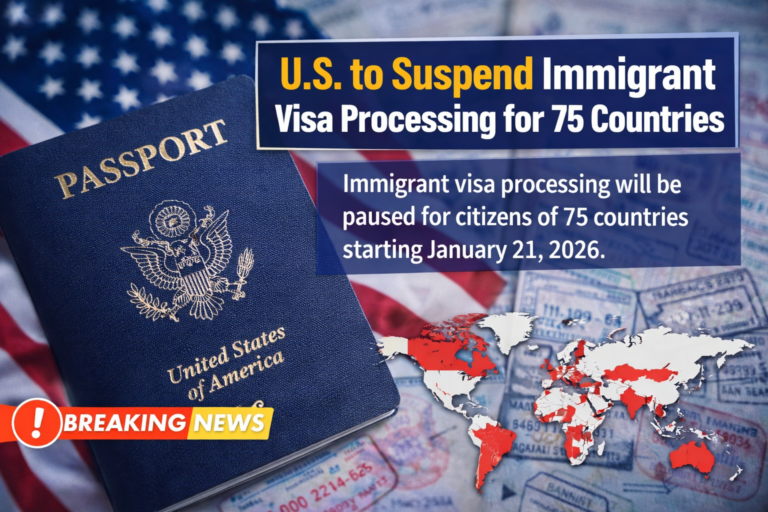
U.S. to Pause Immigrant Visa Processing for Applicants From 75 Countries (Starting Jan 21, 2026)
Multiple major outlets report that the U.S. State Department will pause (suspend) immigrant visa processing for applicants from 75 countries as part of an intensified immigration crackdown focused on “public charge” screening—i.e., whether an applicant is likely to depend on certain government benefits.
This article summarizes what’s known right now, provides the full list of 75 countries, and explains who may be affected, what may not be affected, and what families should do next.
What exactly is being paused?
Immigrant visa processing (consular processing)
According to Reuters and ABC News, the State Department is suspending processing for immigrant visas for nationals from the listed countries beginning Jan 21, 2026, while it reassesses procedures related to determining whether an applicant is likely to become a “public charge.”
Important: “Immigrant visa processing” typically refers to visas issued by U.S. embassies/consulates abroad for people who intend to immigrate permanently (e.g., family-based immigration, employment-based immigration via consulates, etc.).
What does NOT appear to be affected?
Reuters specifically reports that visitor visas are not affected.
That said, “not affected” does not necessarily mean “no extra scrutiny.” Screening rules can tighten even when a category remains open.
Why is the U.S. doing this?
Reuters quotes the State Department’s spokesperson saying the department will use long-standing authority to deem ineligible potential immigrants who would become a public charge and “exploit” public benefits, and that processing will pause while procedures are reassessed.
ABC News similarly reports the pause is meant to prevent entry of those deemed likely to need public benefits, referencing an internal memo and a State Department statement.
Are there exceptions?
The Guardian reports the list comes from a State Department cable obtained by the outlet. According to that cable, exceptions include:
- Dual nationals traveling with a passport from a country not on the list, and/or
- Applicants able to show travel serves an “America First” national interest (as described by the cable).
The Guardian also reports that if a visa has been approved but not printed, the consular officer “must refuse the case” (as described in the cable).
The full list of 75 countries (as reported)
Below is the full list of 75 countries published by The Guardian.
- Afghanistan
- Albania
- Algeria
- Antigua and Barbuda
- Armenia
- Azerbaijan
- Bahamas
- Bangladesh
- Barbados
- Belarus
- Belize
- Bhutan
- Bosnia and Herzegovina
- Brazil
- Myanmar
- Cambodia
- Cameroon
- Cape Verde
- Colombia
- Côte d’Ivoire
- Cuba
- Democratic Republic of the Congo
- Dominica
- Egypt
- Eritrea
- Ethiopia
- Fiji
- The Gambia
- Georgia
- Ghana
- Grenada
- Guatemala
- Guinea
- Haiti
- Iran
- Iraq
- Jamaica
- Jordan
- Kazakhstan
- Kosovo
- Kuwait
- Kyrgyzstan
- Laos
- Lebanon
- Liberia
- Libya
- North Macedonia
- Moldova
- Mongolia
- Montenegro
- Morocco
- Nepal
- Nicaragua
- Nigeria
- Pakistan
- Republic of the Congo
- Russia
- Rwanda
- St Kitts and Nevis
- St Lucia
- St Vincent and the Grenadines
- Senegal
- Sierra Leone
- Somalia
- South Sudan
- Sudan
- Syria
- Tanzania
- Thailand
- Togo
- Tunisia
- Uganda
- Uruguay
- Uzbekistan
- Yemen
Who is most likely to feel this immediately?
1) Family-based immigrant visa applicants abroad
If a spouse/parent/child case is being processed at a U.S. consulate abroad in one of the listed countries, the case may be paused at the “decision/issuance” stage depending on how the directive is applied.
2) Employment-based immigrant visa applicants abroad
People completing the final step of an employment-based green card through consular processing may also be impacted if their nationality is on the list.
3) People with interviews scheduled near/after Jan 21
If your interview is close to the effective date, you may see delays, reschedules, or administrative holds depending on post-specific instructions.
What you should do if this affects you (practical checklist)
This is general information, not legal advice.
-
Confirm your visa type
- Are you in an immigrant visa process (permanent immigration), or a visitor/nonimmigrant process? Reuters reports visitor visas are not affected, but immigrant visa processing is.
-
Check where your case is being processed
- Each embassy/consulate may implement operational changes differently (appointment availability, local backlogs, etc.).
-
Monitor official communications
- Watch for messages from the consular post and the State Department.
- Save copies/screenshots of any appointment notices or portal updates.
-
Prepare stronger financial documentation
- Because the stated reason involves public charge screening, it’s wise to have organized evidence of:
- Affidavit/support documents (if applicable)
- Employment/income
- Assets, savings
- Sponsor details (where relevant)
- Fragomen notes the pause is tied to reassessing procedures for determining public charge inadmissibility.
- Because the stated reason involves public charge screening, it’s wise to have organized evidence of:
-
Speak with an immigration attorney for case-specific options
- Especially if you have urgent timelines (medical, family emergencies, age-out risk, expiring documents).
What’s still unclear (and why that matters)
Even though Reuters confirms the pause and start date, key operational details are still not fully public, including:
- Whether all steps are paused or only final issuance/decisions
- How exceptions will be applied in practice
- Whether some visa subcategories will receive prioritized handling